Diversion Loads
What is a diversion load, and do I need one.
Diversion controllers work by diverting excess energy from the wind turbine to a diversion or "dummy load". This diversion allows the turbine to remain under a load at all times. A solar panel may be safely disconnected from the batteries, but an active wind turbine should never be disconnected from its load (battery/diversion load). When a wind turbine is not loaded, it can easily speed out of control in high wind events, which can lead to catastrophic failure of the turbine as well as the possibility of damage and injury to other property and people. It is very important that your turbine has a very reliable load at all times.
If you have a solar only system (or a system that does not include a wind turbine) you do not need a diversion load.
About load diversion: Monitor the battery voltage, and if it should rise to a predetermined level, connect a diversion load of sufficient size to the battery or energy source to prevent the battery voltage from increasing any further. The amount of time the diversion load is connected is generally only 10 to 30 seconds. In this amount of time, the battery voltage will have dropped enough to be back in the normal region. The controller will continue to engage and disengage the relays as often as necessary to prevent battery overcharge. The microprocessor (in the Coleman Air Controllers) uses several advanced algorithms to prevent rapid relay cycle, yet it is common for the relays to be engaged and disengaged a few times a minute.
We believe it is far better to leave the wind turbine connected to the batteries at all times. When you remove the battery-level voltage from a wind turbine and send its power directly to a load, then unless the diversion load offers an exact amount of resistance as did the battery, the turbine will immediately see either a reduction or increase in load. At the same time, the battery now has no charge source at all. When you allow the turbine to see the batteries along with the load at all times, the turbine remains more within its design realm.
A diversion load needs to be larger (by at least 20%) than the sum total of all your wind/hydro charge sources combined. When the diversion load is too small, battery voltage may continue to rise even when the dump is active. Light bulbs and similar loads are not good dummy loads, since they will fail and you may be left with no method to dump the excess energy.
A common dummy load is thought to be a standard 120vac, 2000 watt heating element, but it will generally take quite a few of these to actually provide much load. These elements are designed for 120 volts, not low voltage D/C. When you put them in a lower voltage system, the actual amount of power they can dissipate is reduced by a factor of four.
Example: 2000 watts / 120 volts = 16.66 amps. Resistance = 120 / 16.66 = 7.2 ohms.
| Nominal battery | Default dump | Amps and watts at dump | Elements needed for a 1000 watt turbine |
|---|
| 12 volts | 14.4 volts | 2 Amps, 28.8 Watts | 35 elements |
| 24 volts | 28.8 volts | 4 Amps, 115 Watts | 7 elements |
| 48 volts | 57.6 volts | 8 Amps, 460 Watts | 3 elements |
For low voltage systems, the 2000 watt, 120VAC domestic hot water element is really not very practical. These elements must also be in water at all times, and the water must allow for continuous heating without boiling.
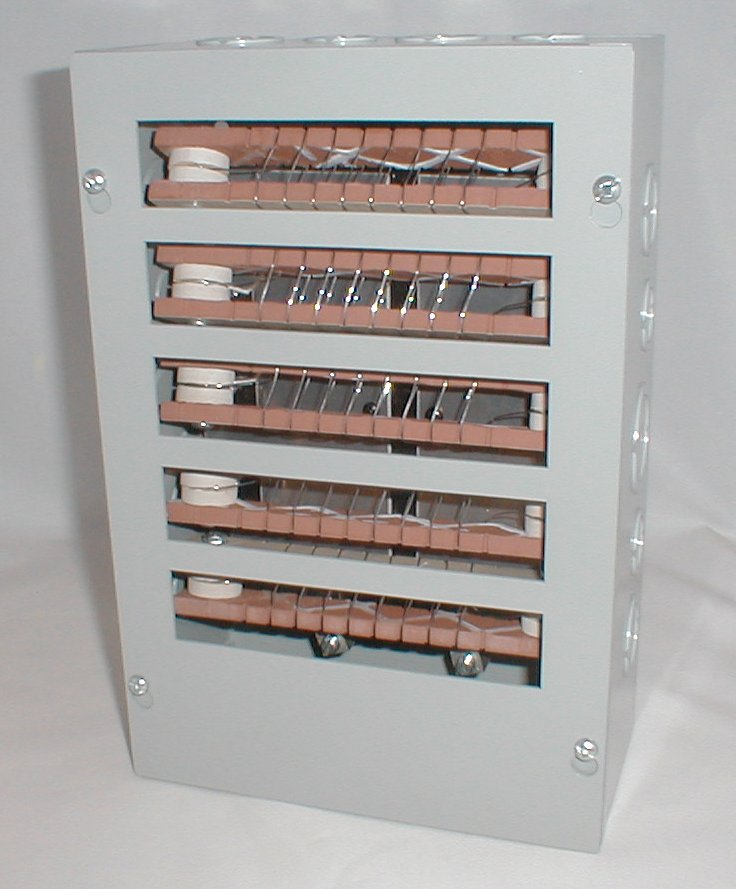
A much more acceptable dummy load is to use power resistors.
| Nominal battery | Default dump | Resistance | Amps and watts at dump | 500 watt turbine | 1000 watt turbine |
|---|
| 12 volts | 14.4 volts | 2 Ohms | 7.20 Amps, 103 Watts | 5ea 100 watt 2 ohm | 10ea 100 watt 2 ohm |
| 24 volts | 28.8 volts | 10 Ohms | 2.88 Amps, 115 Watts | 5ea 100 watt 10 ohm | 10ea 100 watt 10 ohm |
| 48 volts | 57.6 volts | 25 Ohms | 2.3 Amps, 132 Watts | 4ea 100 watt 25 ohm | 8ea 100 watt 25 ohm |
Place multiple resistors in parallel for a higher wattage load. When you place same value resistors in parallel, you double the wattage rating, and 1/2 the resistance. You cannot simply use a lower value resistance without also increasing the wattage rating of your resistor.
Extended Diversion Mode (EDM): When you enable this mode (on Coleman Air controllers that have this feature), and the batteries reach the trip point, the controller will engage the relays for approximately five minutes or until batteries are depleted by 15%, whichever comes first. EDM is useful for water pumps or small grid-tie inverters that you do not want turning on and off every few seconds.
The load you choose must be 100% dependable if this controller is being used to prevent battery overcharge. Grid-tie inverters are not a load if the grid fails. If you will be using EDM with a load that may not be present at all times, use another controller in parallel with a slightly higher trip point and a 100% dependable diversion load. Do not attempt to hook up highly inductive loads, as the relays will be damaged due to high currents during motor start.
Source: getawaypower.com/2019/01/diversion-loads/