Grounding and Lightning.
A properly grounded system is extremely important for both safety and reliability. An un-grounded system is significantly more likely to be damaged during an electrical storm than a properly grounded system. It stands no chance against an EMP burst.
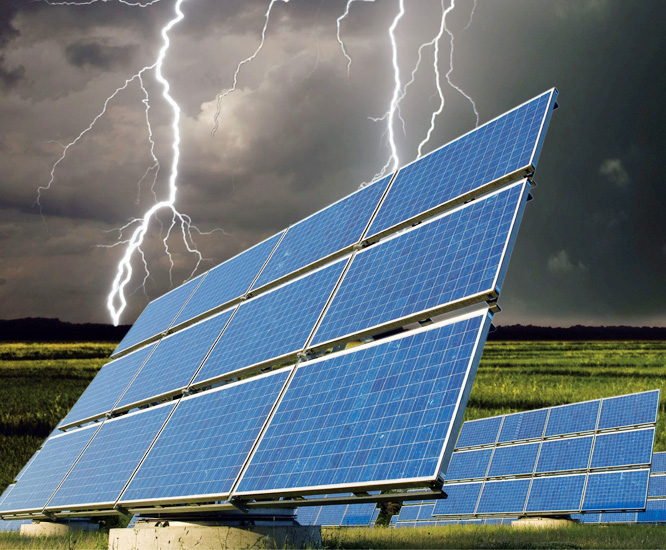
Solar panels and wind turbines act as lightning antennas or "magnets" as they are always mounted in a manner that opens them up and elevates them, which often makes them the most likely target for a lightning strike.
It is important to note that due to the relationship between the earth's ground and the electrically charged sky during an electrical storm, the lightning bolt does not actually seek the highest object; instead the highest object actually attracts the lightning bolt to it, with an initial burst of conductivity that starts from the ground up, not the sky down. If you put a wind turbine up in the air and that tower is not grounded, then you can fully expect it to be hit by a lightning strike, which will result in equipment failure. This is a "not if, but when" scenario and then "how often". When a lightning bolt hits an ungrounded tower, the entire voltage/current spike will travel down the wires that lead directly to your expensive controller and inverter, looking for a ground.
Many electronic devices employ MOVs to help fight against electrical surge. Many controllers use over-voltage surge protection devices and circuits, but they may be no competition to a direct lightning hit. Many of our controllers have survived direct lightning hits due to the internal protective circuits yet the connected equipment like meters, inverters, etc. are damaged beyond repair.
Proper grounding is paramount! Damage due to lightning strikes and high voltage surges are not protected under most warranties. To make matters worse, the lightning strike does NOT have to be direct. Highly charged atmosphere may be present for many miles around an active lightning area. Indirect electrical charges can also be present during a sand-storm, high wind event, or very low humidity, generating static electricity that far exceeds hundreds or even thousands of volts.
A properly grounded system is comprised of (at the very minimum) 6' ground rods and large (6 to 8 gauge) bare copper wire that ties the enclosures and system negatives directly to the ground rod. Ground rods (plural) should be placed as close to turbine towers and solar panel installation as possible. The towers and panels should be tied directly to the ground rods, with few or no splices. The battery bank's negative (or buss) should also be tied to a grounding rod.
Solar Panels: Ground wires need to be as short as possible and as numerous as required to ensure each and every panel is grounded. Each vertical row of solar panels requires a separate ground wire running vertically down to the ground. Multiple ground wires may be combined into a single ground rod. Generally a new ground rod should be driven for every 8 to 12 feet of lateral ground distance, driven 6' or 8' deep -- the more the better, the deeper the better. Use an aluminum grounding strap between each solar panel frame (even if you have mounted the panels to an aluminum rack). Alternatively, you may tie each and every solar panel frame directly to the grounding wire via a ground lug or bolt.
For EMP protection, the solar panel wires (MC-4 cables etc.) MUST be enclosed in metal conduit for the trip down to the controller; failure to do this will defeat the EMP Hardening of the controller.
Wind turbines: It is imperative that the wind turbine pole (tower) is grounded at its base. It is not enough that the pole is driven into the ground. You MUST provide a copper ground wire from the base to the top, and this wire must be tied to a ground rod(s) driven into the soil at least 6 feet. The wind turbine housing itself should also be tied to this or another ground wire if at all possible. The wires from the wind turbine must either be placed underground or run in metal conduit before they terminate at any piece of electronics, including the rectifier, break switch or controller. Ground the conduit itself via a grounding strap directly to the ground rod before it gets to any enclosure. Do not run bare wires into an enclosure.
Enclosures: Each and every enclosure must be grounded directly via a copper ground wire. Each of these wires must make a separate run to the nearest ground rod or a grounded buss bar. Do not daisy chain copper ground wires; this does not work but instead can bring an otherwise unaffected enclosure into the direct path of the high-energy burst.
Battery bank: The negative ground post or ground buss of the battery bank must also be grounded. This is one of the most important grounding places, yet often overlooked. If your battery bank is not grounded it can easily pass the high energy burst back into EVERY piece of equipment that is connected to it!
It is difficult to over-ground, but it is actually possible. Please research solar system "ground loops" to ensure you are not introducing a new set of problems. This article is an introduction -- please research "solar or wind systems grounding" for more detail. An ungrounded system is also a safety hazard. No safety-conscious installer will ever design and/or install a system that fails to include grounding.
Enjoy your system -- stay safe!
Source: getawaypower.com/2019/03/grounding-and-lighting/